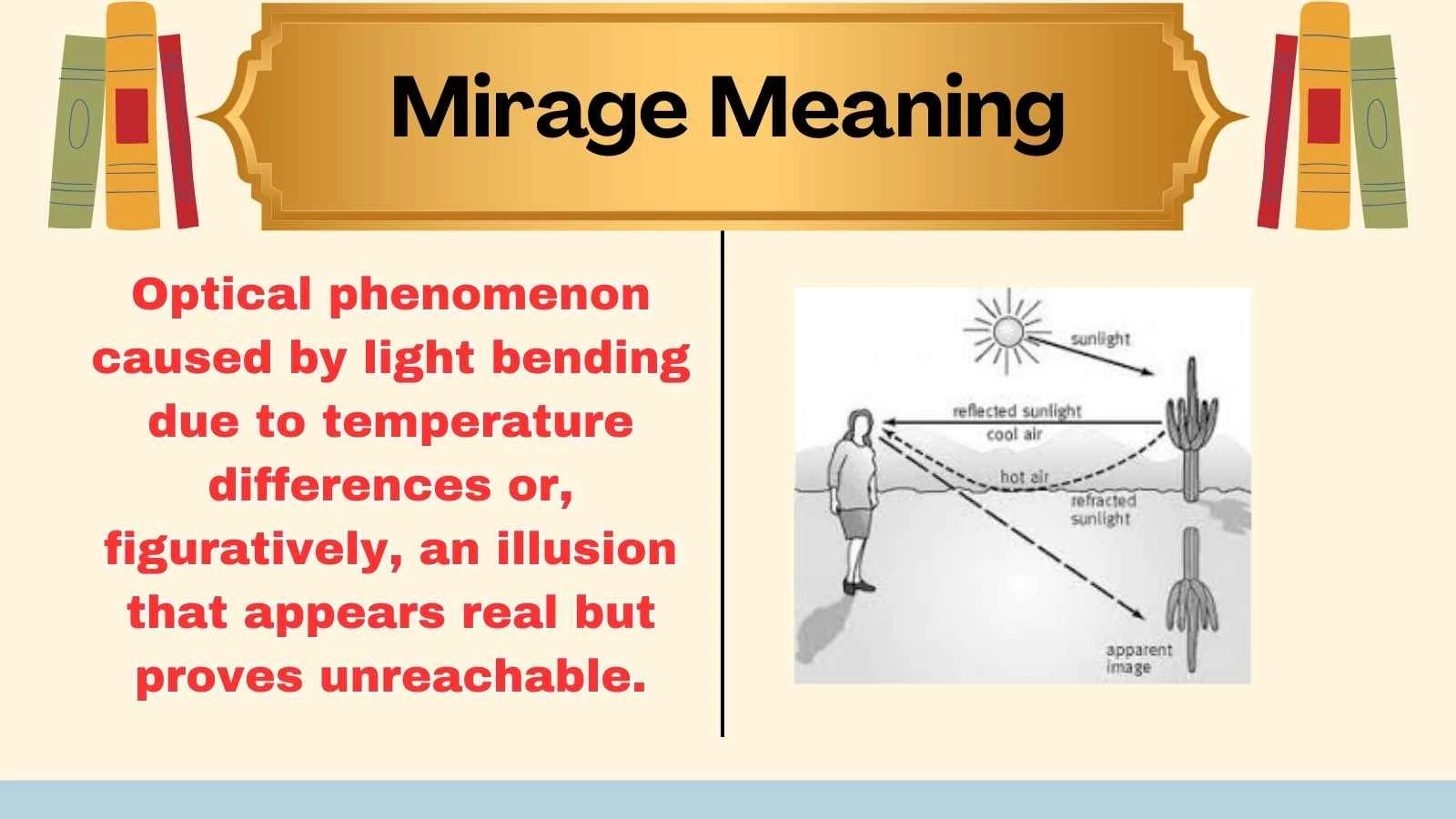
Mirage Meaning refers to an optical illusion where light bends due to temperature differences in the atmosphere, causing distant objects to appear as water, reflections, or floating images.
Commonly seen in deserts, highways, and hot environments, a mirage tricks the human eye by refracting light rays, creating visuals that seem real but are physically unreachable.
Understanding the mirage meaning is important in science, geography, physics, and everyday language, as the term is also widely used in a metaphorical sense. Beyond nature, mirage often symbolizes false hope, illusion, deception, or something that appears achievable but isn’t. From heat mirages to inferior and superior mirages, this phenomenon highlights how environmental conditions influence perception.
Mirage Meaning (Snippet-Optimized Definition)
Mirage meaning refers to an optical phenomenon caused by light bending due to temperature differences or, figuratively, an illusion that appears real but proves unreachable.
In everyday language, a mirage is something you believe exists until reality corrects you.
Quick clarity:
- Physical mirage → tricks your eyes
- Figurative mirage → tricks your expectations
That contrast is why the word remains powerful in science, literature, and daily speech.
Literal Meaning of Mirage (Scientific Explanation)
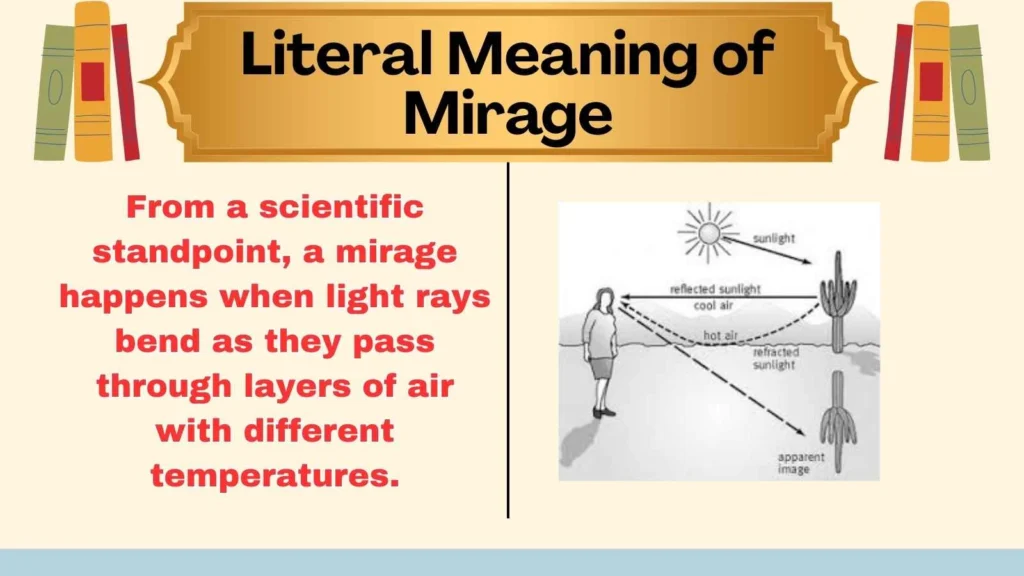
From a scientific standpoint, a mirage happens when light rays bend as they pass through layers of air with different temperatures. This bending, called refraction, causes objects to appear displaced or distorted.
Hot air sits closer to the ground. Cooler air floats above it. When light travels through these uneven layers, your brain misinterprets where the image actually sits.
That’s how a dry desert suddenly looks like it has water.
How a Mirage Forms Step by Step
- Sun heats the ground intensely
- Air near the surface becomes hotter and less dense
- Light bends upward as it passes through cooler air
- Your brain assumes light travels straight
- Result: a false image appears
Your eyes do nothing wrong. Your brain fills in the gaps.
Types of Mirages
Not all mirages behave the same way. Science classifies them into distinct types.
Inferior Mirage
- Most common type
- Appears below the actual object
- Seen on hot roads or deserts
- Looks like water or a shiny surface
Superior Mirage
- Appears above the actual object
- Happens in cold regions or over icy water
- Can make ships look like they’re floating
Fata Morgana
- Complex, layered mirage
- Creates stretched or stacked images
- Often seen over oceans or polar regions
- Inspired myths and legends
Fact Table: Types of Mirages
| Type | Where It Appears | Visual Effect |
|---|---|---|
| Inferior | Hot ground | Looks like water |
| Superior | Cold regions | Objects float upward |
| Fata Morgana | Oceans, polar areas | Distorted, stacked shapes |
Figurative Meaning of Mirage
Beyond science, mirage meaning shifts into metaphor.
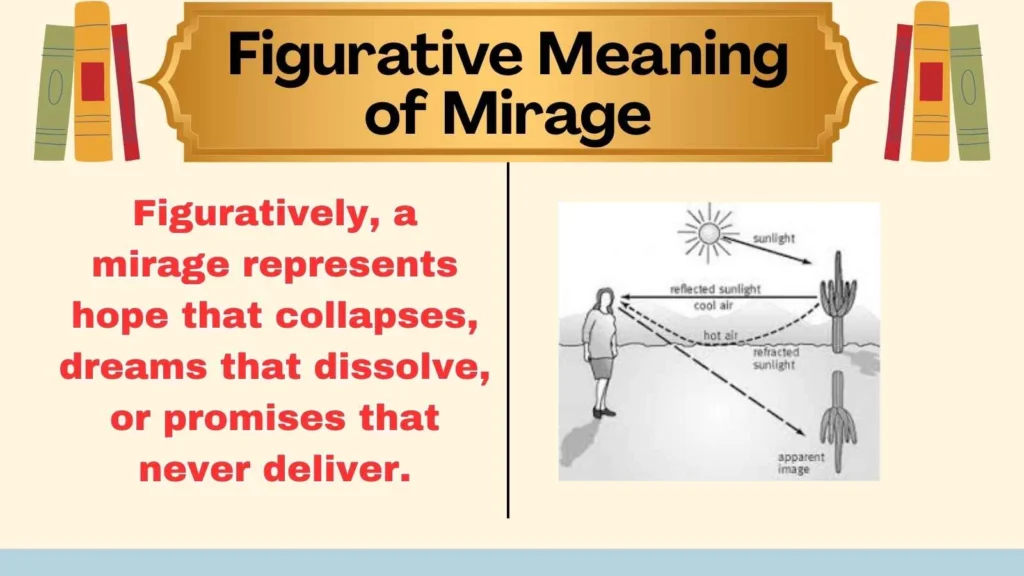
Figuratively, a mirage represents hope that collapses, dreams that dissolve, or promises that never deliver. It describes moments where belief runs ahead of reality.
People use the word when something:
- Looks perfect from a distance
- Motivates action
- Disappears upon closer inspection
For example, a job that seems ideal until you start working there. Or a relationship that feels magical until the truth surfaces.
Mirage as a Symbol (Psychological and Emotional Meaning)
Psychologically, a mirage taps into how humans process desire and expectation. The brain fills empty spaces with optimism. That tendency makes mirages emotionally powerful.
A mirage often symbolizes:
- False hope
- Emotional deception
- Idealized futures
- Temporary motivation
However, not all mirages are negative. Sometimes, chasing one teaches clarity.
Analogy:
A mirage is like chasing a rainbow. You never reach it, but the journey changes how you see the sky.
Real-Life Examples of Mirage
Understanding mirage meaning becomes easier with real situations.
Physical Examples
- Highways appearing wet on summer days
- Desert travelers mistaking light reflections for water
- Ships appearing to hover above the sea
Figurative Examples
- Quick wealth schemes promising instant success
- Social media lifestyles that look perfect but aren’t
- Idealized versions of people that don’t exist
Case Study:
A startup attracts investors with flashy projections. Reality hits. Revenue never materializes. Investors later call the growth projections a mirage.
Mirage in Literature, Media, and Pop Culture
Writers love the word mirage because it carries visual beauty and emotional depth.
In literature, mirages often represent:
- Lost dreams
- Self-deception
- The gap between appearance and truth
Poets use mirage imagery to show longing. Filmmakers use it to symbolize unreachable goals. Songwriters use it to describe love that fades.
Why “mirage” beats “illusion”:
- Mirage feels temporary
- Illusion feels intentional
- Mirage implies hope first, disappointment later
That emotional arc matters.
Common Phrases and Expressions Using “Mirage”
Language keeps mirage alive through expressions.
Common examples include:
- A mirage of success
- Love turned out to be a mirage
- A mirage of happiness
- The promise was a mirage
Each phrase implies belief followed by realization.
Tone Tip:
Mirage fits reflective or emotional contexts better than technical ones.
How to Use “Mirage” in a Sentence
Using mirage correctly depends on context.
Simple Usage
- The water on the road was a mirage.
- His confidence felt like a mirage.
Figurative Usage
- Overnight success is often a mirage.
- The dream job turned out to be a mirage.
Advanced Usage
- What seemed like freedom slowly revealed itself as a mirage shaped by desire.
Synonyms and Related Words for Mirage
Choosing the right synonym depends on nuance.
Direct Synonyms
- Illusion
- Deception
- Phantom
Near-Synonyms
- Fantasy
- Delusion
- Chimera
Often Confused Words
- Hallucination (mind-generated, not light-based)
- Reflection (actual image source exists)
Comparison Table
| Word | Key Difference |
|---|---|
| Mirage | Appears real but isn’t |
| Illusion | Trick or misinterpretation |
| Hallucination | Mind-created perception |
| Delusion | Persistent false belief |
Mirage vs Similar Concepts
Understanding contrast sharpens meaning.
1. Mirage vs Illusion
- Mirage relies on environmental conditions
- Illusion relies on perception tricks
2. Mirage vs Hallucination
- Mirage has a physical cause
- Hallucination originates in the brain
3. Mirage vs Delusion
- Mirage fades when approached
- Delusion persists despite evidence
Mirage Meaning in Modern Contexts
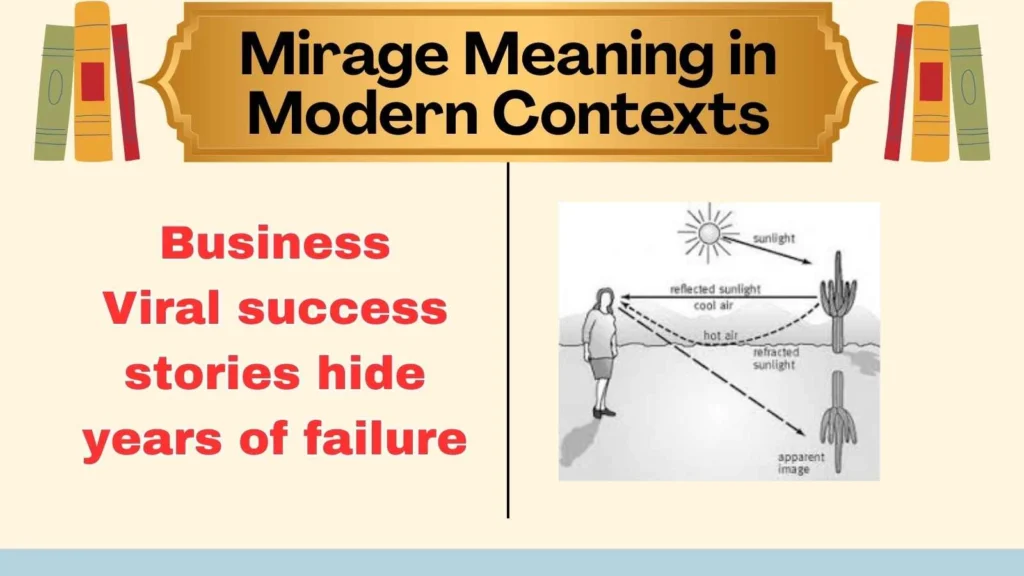
Modern life creates new mirages daily.
Business
- Viral success stories hide years of failure
- Easy money promises lure beginners
Self-Improvement
- Instant transformation myths
- Motivation without discipline
Social Media
- Perfect lives curated for clicks
- Happiness filtered through screens
Key Insight:
Modern mirages spread faster because images travel faster than truth.
FAQs About Mirage
Is a mirage real or imaginary?
A mirage is real in cause but false in appearance. Light behaves correctly, but perception misleads you.
Can a mirage be photographed?
Yes. Cameras capture mirages because they record light exactly as it bends.
Is mirage always negative in meaning?
No. Sometimes it motivates action or self-discovery before fading.
Why do mirages disappear when approached?
Changing temperature and angle disrupt the light refraction causing the image.
Are mirages dangerous?
They can be, especially in deserts where travelers chase nonexistent water.
What is the simplest mirage meaning?
A mirage is something that looks real but isn’t.
Is mirage a scientific or emotional term?
It works as both, depending on context.
Does mirage always involve heat?
Most do, but cold-based mirages also exist.
Can people experience emotional mirages?
Yes. Unrealistic expectations often act as emotional mirages.
Why is mirage used metaphorically so often?
Because it perfectly captures hope followed by realization.
Conclusion
Mirage meaning stretches far beyond shimmering roads and desert illusions. It explains how light bends, how hope forms, and how belief sometimes outruns reality.
Whether you encounter a mirage through science, language, or life experience, the lesson remains consistent. Not everything that shines is solid. Some things exist only long enough to teach you what’s real.
Understanding mirage meaning doesn’t just sharpen vocabulary. It sharpens perception—and that’s far more valuable than any illusion.

Jhon is a passionate writer at AniversaryLove.com, dedicated to sharing heartfelt messages and creative ways to celebrate love and special moments. With a flair for crafting emotional and relatable content, he inspires readers to express their feelings in meaningful ways. His words connect hearts and make every celebration unforgettable.